
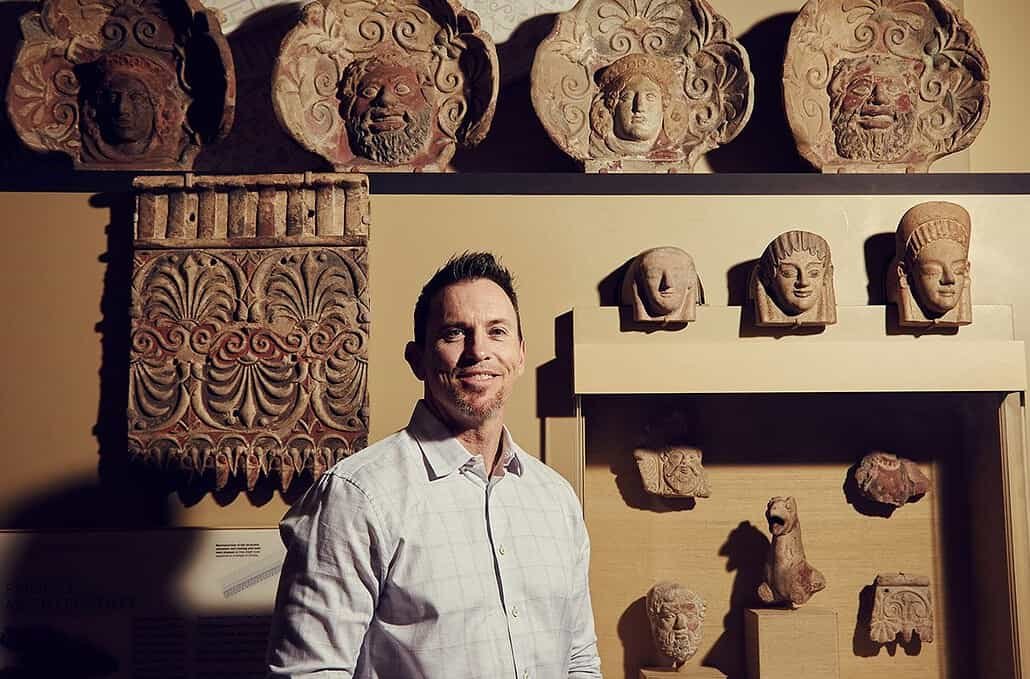
Former baseball star Brad Lidge rolls the dice on second career as archaeologist
From ScienceMag:
As a star relief pitcher for the Philadelphia Phillies when they won the 2008 World Series, Brad Lidge would chew gum only in odd-numbered innings and go unshaven for days during a “hot” streak. Professional athletes are notorious for indulging in such quirky behaviors in hopes of improving their chances of success on the playing field. Now an archaeology Ph.D. student at the University of Colorado (CU) Boulder, Lidge thinks the same might have been true of the Etruscans, a pre-Roman civilization in central Italy whose widespread use of dice suggests they were seeking divine intervention 2800 years before Lidge became a sports hero in Philadelphia.
Hints of what would become Lidge’s second career started early. Growing up in Colorado, a rich area for paleontology, Lidge enjoyed searching for dinosaur bones when he wasn’t playing baseball. After hanging up his cleats in 2012, he rekindled his passion for buried treasure as a volunteer on a dig at the site of the ancient Roman city of Carsulae. And he got lucky.
“On my first day I flipped over some soil and there lay some Roman coins—a fourth century [C.E.] coin from [when] Constantine [was emperor],” he recalls. “I couldn’t believe they were right there underneath our feet. It brought me an extreme sense of joy, and at that point, I kind of knew what I wanted to do next.”
Lidge didn’t have to worry about making a living as an archaeologist, having earned some $55 million during his 11 seasons as a major leaguer. But he didn’t want to rely on his fame to break into the profession. “There’s a lot of imposter syndrome for a retired athlete entering into a new field, and I wanted to do it the right way,” he explains. So while he continued to work as a volunteer on digs in Italy, he enrolled in an online master’s program at the University of Leicester and earned his degree in 2017.
Now, 2 months from his 50th birthday, Lidge hopes obtaining a Ph.D. will be the final step in a path to directing his own dig. “If you don’t have those initials after your name,” he says, “it is very difficult to work with the governing bodies that must give their approval before you can direct a project.”
His adviser, CU anthropologist Gerardo Gutiérrez, has no doubt Lidge will do well if given the chance. “He’s very mature, he’s serious about his goals, and he’s already famous, so he’s not doing it for his ego,” Gutiérrez says. “I wasn’t aware that he was a famous baseball player because he didn’t mention it in his application.”
While working in Italy, Lidge became fascinated with the inscriptions on Etruscan artifacts. That eventually led him to Anthony Tuck, a University of Massachusetts Amherst archaeologist who directs excavations at Poggio Civitate, an Etruscan settlement dating from the eighth century B.C.E.
“Brad is deeply curious and incredibly committed to learning how research is done,” Tuck says. “So it took him no time at all to get up to speed on what we do.” That work includes a summer school for undergraduates from around the world that Tuck runs at the site.
Being a mentor to younger players in the Phillies’s organization, Lidge believes, has served him well when teaching at Poggio Civitate. “With the Phillies I loved being able to sit down with the young guys and teach them the nuances of the game,” he explains. “Those leadership skills have helped me when we’re out there at an excavation and in the classroom. … It’s also really cool to see the look in their eyes when a student discovers something really old and I can help them understand how special and unique it is.”
Poggio Civitate is where Lidge and Tuck found those dice. In February they co-authored a paper discussing how the dice might have been part of rituals to divine upcoming events as well as for gaming or other recreational activities.
In describing their quest to understand what those objects might have meant to its residents, Tuck and Lidge note the potential similarity to another set of “irrational, ritualized behaviors designed to ameliorate performance … among a subset of baseball players, relief pitchers.” It’s almost certainly the only reference in the scientific literature to flame-throwing hurlers like Lidge, who earned the nickname “Lights Out” after he posted a perfect record—41 saves in 41 appearances—during that magical 2008 season.

To gain additional expertise, Lidge also sought out Italian archaeologist Luca Nejrotti, who directs another Etruscan site. “I went there to up my game in terms of understanding data sets and geographic information systems and x-ray fluxes.” Lidge bought himself a portable x-ray fluorescence machine, a purchase enabled by his baseball earnings, which can be used to determine the elemental signature of certain kinds of materials. That can come in handy, say, for identifying the clay used in a particular piece of pottery and, thus, its likely origins.
His earnings as a baseball player have also helped Lidge literally pay back the warm welcome he enjoyed from archaeologists in launching his second career. In 2010, while Lidge was still on the Phillies, archaeologists Jennifer Houser Wegner and Josef Wegner, curators in the Egyptian section of the Penn Museum, gave him a tour of the museum. Now, Lidge is helping fund Josef Wegner’s ongoing excavation at Abydos, one of the oldest cities in ancient Egypt. He’s also become a major donor to the museum, which this year appointed him to its Board of Advisors.
Interpreting ancient Etruscan symbols may seem worlds away from throwing a small orb past other elite athletes. But Lidge says he’s never been satisfied doing only one thing.
“As a professional baseball player, you’re at the field for 9 or 10 hours a day, and you need time off,” he says. “So having something different to do that you really enjoy is really important. That’s what archaeology has been for me. And I’m just lucky to have had a chance to pursue my passion.”

Leave a Reply
Want to join the discussion?Feel free to contribute!