
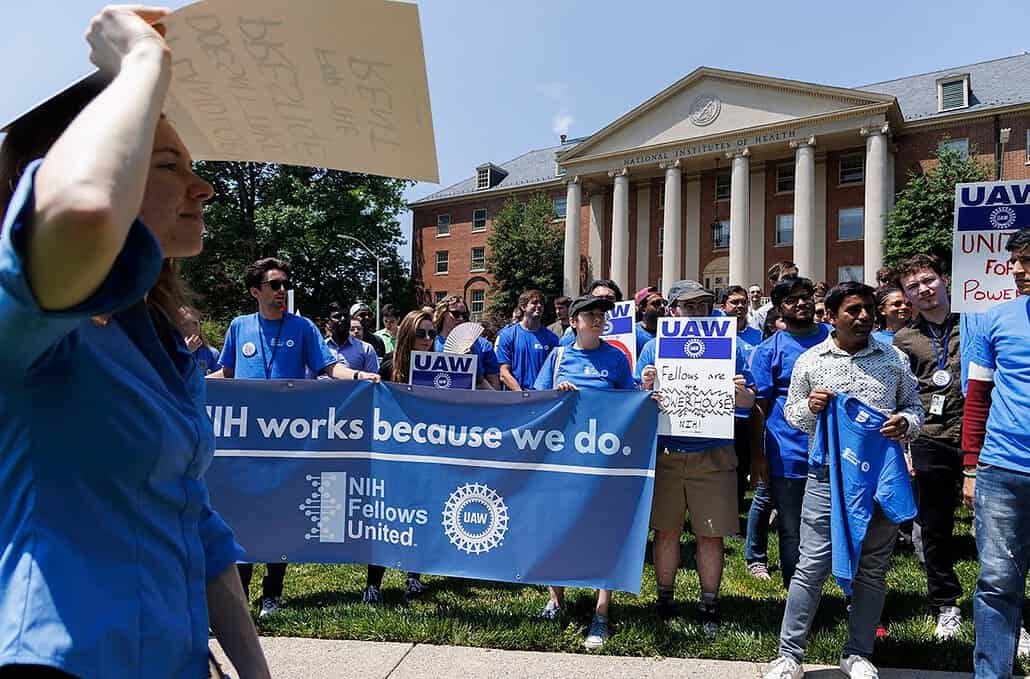
Early-career researchers’ right to unionize at NIH is upheld, against agency’s petition
From ScienceMag:
The union representing early-career researchers at the U.S. National Institutes of Health won a victory yesterday when the federal entity that oversees labor relations between the federal government and its employees rejected a petition NIH filed in March that questioned the union’s legality. The decision means the union’s contract—which limits work hours, guarantees paid parental leave, and provides protections against harassment, among other provisions—will remain in place. The contract is the first of its kind negotiated by scientists at a federal research facility.
“We hope the NIH accepts the decision and stops pursuing this petition,” says Ph.D. student Emilya Ventriglia, president of NIH Fellows United, which represents research fellows, clinical fellows, postdocs, Ph.D. students, and others who work at NIH under term-limited appointments. “It’s really a waste of the public’s money.”
The dispute centered on whether all the group’s members count as “employees” with a right to unionize, as opposed to being primarily students or “trainees.” In a July hearing held by the Federal Labor Relations Authority (FLRA), NIH representatives argued that the thousands of postdocs, Ph.D. students, and college graduates who work in NIH labs through training programs didn’t qualify. “They are not employees,” Lori Conlan, acting director of NIH’s Office of Intramural Training & Education, testified during the hearing, according to a transcript. NIH didn’t respond to a request for comment.
The agency had made the same argument briefly in 2023, ahead of the union’s formation. But NIH withdrew that stance and proceeded to engage in contract negotiations. A final contract was ratified in December 2024.
In this week’s decision, FLRA stated that NIH didn’t have grounds to challenge the union because “there is no evidence” the union had fundamentally changed since FLRA originally approved it. “To demonstrate that a previously certified unit is no longer appropriate, a party must prove that substantial changes have altered the scope or character of the unit.”

Leave a Reply
Want to join the discussion?Feel free to contribute!